This blog is dedicated to my friend, P., who lives in Germany, and whose manner became noticeably chilly after the so-called help to Greece began. Here, I'll write all those things I couldn't tell her over the phone.
Εμφάνιση αναρτήσεων με ετικέτα crisis. Εμφάνιση όλων των αναρτήσεων

Κυριακή 30 Σεπτεμβρίου 2012

The demonstrations in Greece

I found a great post about the demonstrations in Greece and I'm posting it, as I found it here:


Let’s think things through for a minute
First of all, Greece is not burning. Granted, lately demonstrations have become more frequent and they tend to turn nasty, but this happens in just one place: the square in front of the parliament. Would you cancel your trip to the States or even New York just because of “Occupy Wall Street”?
Second, the riots are true, they are happening and they are a fact of daily life here in Athens. Yet here I am, an Athenian born and bred, who works downtown every day, showing people around the historic centre, and yet not once have I had any demonstration or riot trouble.

The truth
I understand that anyone who watches the news on TV, the Internet or the papers, may get the impression that the entire country (or perhaps just the entire Athens) is on fire, but it’s not like that at all.
After all, one must not forget that news agencies are in the entertainment business: the more viewers/readers they get, the more money they get from advertising. So it is only natural that they seek sensational news (and spectacular images to go along with them), even if that may mean that in the few seconds (or little space) available for a piece of news, the rest of the story gets cropped away.

What is a Greek riot like?
Most people hear riots and think of Los Angeles, when an entire area of the city was into chaos with property destroyed and lots of casualties. Things in Greece are quite different.
All riots here evolve pretty much the same way (it’s almost a ritual by now):
First a whole lot of people gather in Syntagma square, right in front of the parliament, to protest peacefully. They hold pickets and banners and may shout slogans, in the vain hope that their elected representatives will hear the voice of their electorate…
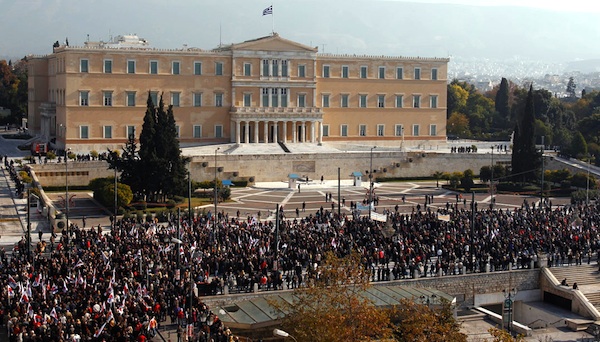
From here.

Of course, the said representatives want nothing of the sort. Instead, they give the police the order to surround the building and prevent the loud plebeians from disturbing their wise leaders.
The police cordon off the parliament but the crowd stays and may become a tad too loud or impolite. Angered by this show of disrespect, the parliamentarians order the police to shoo the crowd who are preventing them from concentrating on voting their country-saving austerity measures.
The police eagerly obey, by throwing tear gas canisters at the crowd…
From here.

Who quickly run away.
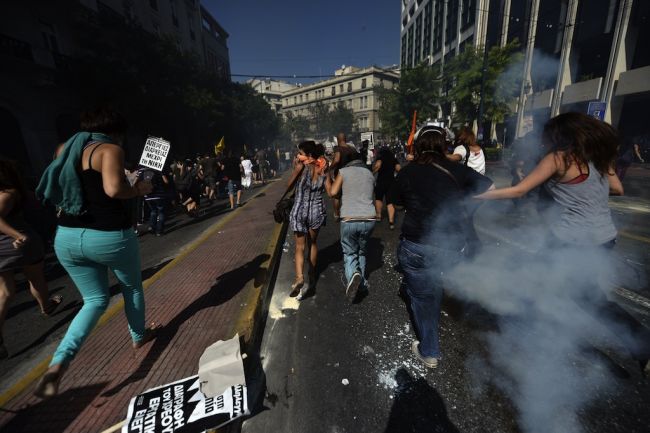
From here.

Only the most determined remain, but they soon will be gone too, because another factor shows up: it’s a group of angry young men, who seem to be in every demonstration waiting for this very moment: they quickly put on full-face gas masks and produce empty beer bottles, petrol and rags from their backpacks. Once the Molotov cocktails are ready, they are hurled at the police.
From here.

The police see this as ample provocation to charge at the few stubborn demonstrators who have not yet disappeared, using even more teargas. Once the “civilians” are well away, the “combatants” (ie the police and rioters) may continue throwing their ammo at each other undisturbed. Since the police’s supply of teargas is inexhaustible, while the youths can always find new projectiles by breaking chunks off the pavement or adjacent buildings, the battle may well continue until the wee hours of the morning. This is the time when reporters get their most spectacular shots, of flames against the night sky.
From here. Demonstrators often use trashcans to make huge bonfires, because heat makes teargas dissipate faster.

When does it all end?
By six o’ clock the next morning, the city crews may start cleaning the square from the debris and people can go about their business as usual. There may be a lingering acrid smell if the police have been too enthusiastic in their use of tear gas (they usually are), but this usually evaporates as soon as the sun is up.
As for the youth? None of them has ever been apprehended, which raises some very interesting questions about who they may be, or about the competence of Greek police, but these are not for me to answer. I’ll simply move on to describe what happens in the rest of the city, during the night when the police and rioters are busy with each other.

A few blocks away from the riots
For the rest of the Greeks, riot night is a night of anger or entertainment, depending on who they are.
Those who are political, are always angry at how the demonstration has again been hijacked by the same mask-wearing youths and how it will be discredited by all news media the next day.
Those who are not, will sit back in their sofas and get ready for a steady stream of entertainment with spectacular videos and breathless reporting that will last until well after midnight.
Those who shun the “box”, go out as usual, taking walks, chatting at cafés or sitting down at taverns in the historic district, just a few squares from the riots. The only inconvenience is that one must take a detour to avoid Syntagma square and that bus routes that cross the centre do not – of course – work.

What about the tourists?
Greece may not be a huge country, but it is certainly larger than a city square. As a prospective visitor you are faced with three options:
  1. Avoid Greece entirely
  2. Avoid Athens
  3. Avoid Syntagma square for that night.
It is not my job to tell you which one you should choose – pick the one you feel most comfortable with. After all, it’s your vacation.
If you have already paid in advance, then think twice before wasting all that hard-earned money. If you feel the capital is too hot for you, you may want to stay in the provinces – there’s plenty to see and do in Greece besides the Acropolis.
If however you feel that the Acropolis is a must you simply can’t miss or you can’t change your plans without losing a considerable sum, then rest assured that, even in downtown Athens, the most important sites are and have always been away from centres of power and therefore have not been disturbed by riots nor clouded by teargas.
If you happen to be so unlucky as to be in Athens on a day of riots, then steer clear of Syntagma square and the nearby blocks (see a map here). The rioters will not target you, nor will the police, but you will get a nasty lungful of smoke or teargas – or both. So play it safe and keep away from that area. You’ll miss nothing more than the changing of the Guard, which you can easily watch here. Go to the Acropolis, see the Museums and take your meals in Plaka instead of Syntagma. If in doubt, ask a local – your receptionist, a friend, your guide. They should be able to show you where to have a good time while keeping your lungs full of nothing worse than a little smog or barbecue smoke.
Now, if you worry that taking a wrong turn may accidentally put you into the path of a petrol bomb, rest assured that such a mistake is impossible, even for the most uninformed. The acrid smell of tear gas wafting from the scene is ample warning to anyone that the area should be given a wide berth.
Whatever you do, enjoy your holiday.

A personal experience
Once, a few years ago, on a cold winter night, I was out with a friend. We had just sat down at a nice tavern and were getting ready to order, when my wife called. “Are you all right?” she said. “Of course I’m all right,” I answered, a bit testily, wondering if recent motherhood had changed my wife into another version of my mom. “Where are you?” she asked again. “I’m in Plaka with Giorgos,” I answered, worrying whether it might be jealousy after all. “There’s rioting downtown, it’s all over the news, don’t you know it?” she asked. I didn’t. Neither of us had heard nor smelt anything out of the ordinary, as if the rioting were miles away, not a mere five minutes’ walk from where we were sitting. Yet the rioting was bad, they said, and it was all over the newspapers the next day.

Παρασκευή 7 Σεπτεμβρίου 2012

"The sorrow of Athens" photo exhibition

News photographer Maro Kouri presented at the 24th International Festival of Photojournalism, "Visa Pour l' Image" at Perpignan,  France, images from her exhibition "The sorrow of Athens".

The photographer says: "In February 2012, a new social class appeared - the nouveau-homeless. Their median age is around 47, 11% of whom hold a university degree, while 23,5% are high school graduates and only 9,3% are illiterate. They are usually the victims of unemployment that has resulted in about 20,000 Greeks sleeping on park benches."


Med_athenskouri-3-jpg


Med_athenskouri-3-jpg


Med_athenskouri-3-jpg


Med_athenskouri-3-jpg


Med_athenskouri-3-jpg


Med_athenskouri-3-jpg


Med_athenskouri-3-jpg


Med_athenskouri-3-jpg


Med_athenskouri-3-jpg


Med_athenskouri-3-jpg


Med_athenskouri-3-jpg


Med_athenskouri-3-jpg


Med_athenskouri-3-jpg


Med_athenskouri-3-jpg


Med_athenskouri-3-jpg


Med_athenskouri-3-jpg


Med_athenskouri-3-jpg


Med_athenskouri-3-jpg


Med_athenskouri-3-jpg


Med_athenskouri-3-jpg


Source: metrogreece


Κυριακή 19 Αυγούστου 2012

Should I stay or should I go? The question many Greeks ask these days

We've all asked ourselves that question. We all weighed the pros and cons, we all talk about it with friends, we all trade stories of people who left, stayed or came back.
This article captures the way Greeks feel these days:

Dilemma for Greek youth: Fight or flee


Maria Papanagiotaki and Aristotle Skalizos, part of Greece’s young professional class. They have been dating for more than two years but have different views on whether to stay in Greece or leave for opportunities elsewhere.
Wandering through central Athens’ Syntagma Square, Maria Papanagiotaki and Aristotle Skalizos stop to perch on a sun-soaked bench as they consider their future. The couple, who have been dating for two-and-a-half years, belong to Greece’s post-junta generation, growing up as the country emerged into its modern democracy.
As Greece’s turbulent history faded into its past, the country’s political landscape remained fraught with nepotism and mismanagement. But the boom times had begun. Greece entered the euro in 2001, and ex-pat money flooded back into the country. It hosted the Olympic Games in 2004, swelling the country with pride.

“It was time to feed my heart, not my mind”

- Christina Psarra

But by 2009 — when the country admitted its deficit was out of control — the financial mirage evaporated. Maria, 34, and 25-year old Aristotle’s generation was caught in the fallout. The couple belong to a young professional class that will help shape their country’s future. Together, they must decide if they are willing to live through — and help alleviate — Greece’s pain.
Their views differ dramatically, and it weighs on their relationship.
A few meters away from where Maria, an electronic mobile technician, and Aristotle, an electronics tester, chat, a man stumbles to his knees, dropping a begging cup. Grasping for it as it rolls away, he ends up splayed on the ground.
It’s a disturbing sight, but one which has become increasingly common in Athens since austerity measures began to bite. Greece’s poverty, suicide and crime rates have increased alongside unemployment and emigration. It is this environment Maria wants to leave. She dreams of life outside of Greece, in the UK or the U.S., where she has relatives. “I have to go,” she says. “I have to leave from here.” Aristotle wants to remain. “I want to stay and fight,” he says. “I don’t want to abandon my country.”
His reasoning is clear: “I love my country.”
Maria and Aristotle
Maria and Aristotle began dating after meeting at their workplace, a Germany-based telecommunications company. The relationship blossomed after, in Maria’s words, “he saw me there, we became friends, he was trying to approach me in any [way]… and finally after eight months we were together.”

“The game is not lost but we are two goals behind”

- George Stathopoulos

They moved in together, but say their financial situation has become increasingly difficult as the crisis has unfolded. Each has taken a significant cut in pay since April, in part because both have seen their work week reduced to four days a week.
They now earn €1,160 ($1,415) a month between them, down from €1,480 ($1,805) two years ago. They pay €300 ($366) in rent and around €65 ($79) a week in groceries, but face extra costs because of the crisis. Since Aristotle’s father’s sculpture business went bankrupt in the recession, the young couple must also help his parents get by, he says.
Neither voted in the June 17 elections, because they could not spare the cash to return to their home villages — €15 ($18) for Maria, and €40 ($48) for Aristotle — to vote.
Pro-austerity package party New Democracy won the election, despite soaring support for the radical left Syriza party.

“I have to go, I have to leave from here.”

- Maria Papanagiotaki

Alexis Tsipras, who heads Syriza, is, like Maria, is in his 30s. Tsipras’s vociferous rejection of Europe’s austerity-driven demands for Greece appealed to discontented youth, with the party capturing 33% of 18 to 34-year-olds, compared to 20% for New Democracy. The surge is all the more dramatic given that Greeks, born in a country where family loyalty is embedded deep in the national psyche, usually vote the way of their forebears.
Maria, for one, would have fallen behind her parents and voted New Democracy. The party now leads a fragile coalition, but that provides no comfort for Maria.
A country fights for its future
Greece’s new government is now renegotiating its bailout package, but there is no guarantee the country will emerge from years of recession. And the country could lose people like Maria and Aristotle overseas, while those with less hope could give in to despair.

“I don’t want to abandon the situation…. because I love my country”

- Aristotle Skalizos

More than 50% of working age Greeks under 26 are without a job. Those just entering the workforce are particularly hard-hit, with 2011 figures from Eurostat showing 56% unemployment among those aged 15 to 19. Around one in four workers under 39 years old are unemployed. Eurostat figures show the extent of the exodus of young workers fleeing Greece’s crisis. In 2010, almost 2.5% of those in their mid-to-late 20s left the country, while around 2% of those aged 30 to 34 emigrated.
Dreams of going abroad
Those choosing to leave must struggle against the desire to stay and help their family, and overcome a deep loyalty to a country which has suffered under civil war, dictatorship, and foreign rule under Germany, now its main paymaster.
Those entering the workforce carry a cultural weight of responsibility to family. Aristotle’s 19-year-old brother, Nick, a student, wants to move to the Netherlands to study fine arts. Holland attracts him because of its place in art history, and the “country and the color of the sky are beautiful,” he says. But any money he earns — after he’s made enough to get by — will be sent back to Greece, to help his family.
Marios-Aristotle Koulouris, a 23-year-old soldier, also wants to go abroad, and study political science. But he wants to return, to break his generation’s “consciousness of dependency.”
Greece, he believes, needs to “rise up and develop its own power, to protect our people’s benefits. Economically and politically, we need to rise up.”
The country’s next generation needs to be taught the value of productivity, he believes. The crisis represents a chance “to change people’s minds…. to abolish the mentality of dependency.”
Coming back home
Some of those who have left Greece have already returned in an effort to help the country they love.

“The country [Netherlands] and the color of the sky are beautiful”

- Nick Skalizos

Christina Psarra, a 27-year-old who works in policy at humanitarian organization Doctors of the World studied at the London School of Economics, while George Stathopoulos, a 33-year-old investment banker studied at Middlesex University. Although their educations opened a world of possibility, both opted to forgo careers abroad to return to Athens.
Christina says when her studies in London were coming to an end last year, she knew it was time to “feed my heart not my mind.”
Christina and George describe Greece as a country where one always cooks extra food in preparation for a guest, where a feisty debate over sport will end with friendly drink, and where parents maintain close contact with children after they leave home. But this often idyllic country today finds itself immersed in anger and fear. And Christina, who is passionate about helping the vulnerable and now works with drug addicts, says she doesn’t know which is more dangerous.
“I’m afraid for other people and myself,” she says.

“Economically and politically, we need to rise up”

- Marios- Aristotle Koulouris

With the option to work overseas, she believes she may be forced to leave, due to Greece’s lack of opportunities. “I have the chance, I have the choice to decide to live abroad. If I am forced to do it, I can do it,” she says.
George believes the country can — should it follow the example of others, such as Turkey — restructure itself into a viable European economy. The revelations of its financial irresponsibility, which led the spiral into bailout, were akin to the country being caught “skinny-dipping” when the tide went out, he says.
George wants to see the country’s red-tape unraveled to allow investment into its promising industries such as tourism and shipping. The problems for Greece are structural, he says, and that can be a “glass half full …you can see that as an opportunity. [If] you realize you have a problem, you can transform how you do business.”
The way he sees it: “The game is not lost but we are two goals behind.”
Marios-Aristotle also sees opportunity in Greece’s future, and he is not afraid of the pain that may still come. “My country [during] its history has passed many greater disasters. So I am not afraid.”
For Aristotle, there is one answer to a difficult question. It goes against his wishes but he will put his relationship with Maria ahead of his country. “I love [Maria], and I will follow her. I will sacrifice,” he says.

(Source: CNN)

Δευτέρα 20 Φεβρουαρίου 2012

Greece is being destroyed by 'respectable' fanatics

The EU, which boasts that solidarity is its founding principle, is forcing Greece into destitution and chaos

By from The Observer, Sunday 19 February 2012.


homeless-men-athens.

 Homeless men in Athens. 'Europe is now offering to revive Greece by impoverishing it; to heal it by harming it.' Photograph: Oli Scarff/Getty Images
 

Greek democracy is being destroyed. Not by soldiers marching with insane slogans on their lips about the inevitable triumph of the German master race, international proletariat or global jihad, but by moderate men and women who think themselves immune to ideological frenzy. Greece's enemies are novel, but no less frightening for that: extremists from the centre ground; the respectable running riot.
Which ever way you cut it, Greece can't win. The EU "bailout" cannot perform the first function of a rescue and save the sufferer from suffering. The Germans, with Dutch and Finnish assistance, are pushing Greece into a death spiral. The EU demands that Greece cuts 150,000 public jobs over three years – the equivalent in terms of population of our government taking 800,000 jobs from the UK public sector. Greek politicians must also accept without a quibble a 22% cut in the minimum wage and further reductions in the welfare state.
Greece is in permanent recession. The economy shrank by 7% in the three months to December 2011. Tens of thousands of family businesses have gone bust. Europe is now offering to revive Greece by impoverishing it; to heal it by harming it. As Tacitus said of the Roman legions' earlier attempt to impose a European union: "They make a desert and call it peace."
Whether Greek society can stand the pressure remains an open question. The parties of the far left and right are flourishing in the polls as the public comes to see its centrist politicians as traitors for trying to appease a hostile EU. Once the Grecian fringe was reserved for the unhinged. The last time I asked Liana Kanelli, spokeswoman for the Greek Communist party, about her country's crisis, she flew off into a rage about how the 1999 Nato intervention to stop Serb nationalists slaughtering Kosovo Muslims was an imperialist plot to extend capitalism into the Balkans. Nothing I could say could wake her from her land of make-believe and return her to the subject at hand.
Her fellow citizens no longer see Kanelli and her kind as dangerous fools, however. Because they oppose the EU, cranks from the left and racists from the right now make more sense to Greeks than their mainstream politicians. The parallels with the 1930s are too obvious to labour.
Whatever the political consequences, every sensible financial commentator understands that the Greek economy can take no more. The "bailout" will merely push it deeper into the mire. The EU's terms do not begin to match the altruism the United States showed to the defeated Germans after 1945. America did not pauperise West Germans as many in France and indeed Washington wanted. America guaranteed their security, then gave them loans from the Marshall Plan that allowed the West German economic miracle to begin. Greece has invaded no one and committed no crimes against humanity. Yet the EU, which boasts that solidarity is its founding principle, is forcing it into destitution and chaos.
The alternative to bowing to the demands of their German overlords is not noticeably better. If Greece were to leave the euro, there would be hundreds of thousands, maybe millions, of law suits, as parties argued whether contracts should be honoured in the old or new currency. Hyper-inflation might set in. The European banking system might collapse. As William Hague says, the euro is a burning building with no exits.
The EU cannot take responsibility for what it has done and be magnanimous for reasons British readers may not grasp. Raised in a Eurosceptic country, we do not understand how an absolute commitment to the European project was a mark of respectability on the continent. Like going to church and saying your prayers for previous generations, a public demonstration of commitment to the EU ensured that the world saw you as a worthy citizen. If you wanted to advance in Europe's governing parties, judiciaries, bureaucracies and culture industries, you had to subscribe to the belief that ever-greater union was self-evidently worthwhile.
Currency union is – self-evidently – a disaster. Admitting that would bring a loss of face too great for the European elites to bear. To take the most discreditable example, Germany and Holland have benefited enormously from the single currency holding down the exchange rate for their goods, while imposing effective tariff barriers on southern Europe.
Instead of saying: "We are rich because they are poor", Angela Merkel and her boorish colleagues imitate the smug, parochial, selfish Bild reader, who thinks that foreigners' problems would be solved if only they could turn themselves into him. Germany insists that the Greek crisis is the result of the corruption of Greek public life. Greek politics is undoubtedly corrupt, although I should add that the first victims of corruption are poor Greeks who cannot afford to bribe officials or hide their savings from the taxman.
But Greek corruption cannot explain why Portugal is in crisis, any more than Italian corruption can explain why Ireland and Spain are in crisis. All five countries are suffering – and France may soon be suffering – because the euro is a monumental mistake. Rather than rectify it, European leaders attack the welfare states, employment protections and public services that the best of the European centre-left fought for after 1945. In the name of saving the euro, everything must go.
As the poverty deepens and the protests swell, the EU's image will change – and not for the better. It was once seen as a haven, which offered Europeans an escape from the terrors of the past. The EU, wrote the perceptive British diplomat Robert Cooper in 2002, is at the forefront of the "postmodern world". Instead of invading each other, Europeans allowed negotiators at Brussels to settle conflicts and regulate everything "right down to beer and sausages".
The EU may have been petty and irritating. It may not have been very democratic. But its avoidance of conflict produced a pleasant, prosperous and peaceful continent.
Europe does not seem pleasant, prosperous or peaceful today. When historians write about the end of its postmodern utopia, they will note that it was not destroyed by invading armies anxious to plunder Europe's wealth or totalitarian ideologues determined to install a dictatorship, but by politicians and bureaucrats, who appeared to be pillars of respectability, but turned out to be fanatics after all.

Κυριακή 29 Ιανουαρίου 2012

Thank The Crisis for less garbage

In the Greek capital, the volume of garbage has fallen by about 30%, due to the country's financial crisis.


This is not because people have begun to embrace a more frugal lifestyle, but simply because households cannot afford basic needs.
In Athens, the largest municipality of Greece, the volume of garbage has fallen by 29% in 2011. Deputy mayor A. Varelas says that in 2010 this drop was around 5 to 6%, but by October 2011 it had reached 27%. “The data for the last two months of 2011 are distorted due to the prolonged garbage strike, but it seems that the reduction in household garbage exceeded 30%.”

The quality of garbage has also changed. Gone are the large cartons of appliances such as fridges and televisions. This is not due to the new phenomenon of immigrants searching cans for recyclables, but to the drastic cut of expenses on the part of households.
It is striking that lately trash cans contain virtually no leftovers. A typical example is the lack of pizza cartons, while two years ago it was not unusual to find ten per can, often with a lot of uneaten pizza still inside. The deputy mayor adds: “These are all but gone now. The cans no longer contain large garbage bags, either. 95% of trash is found in small bags, because households produce less garbage.”

In the open air markets (held once a week in every neighbourhood of the capital) a new category of people has appeared, the leftover collectors. Mr. Varelas says that when the producers pack up after noon, these people ask the cleaning crews to delay cleaning the street until they have time to pick up any eatables among the discarded fruit and vegetables. These new collectors are not the typical homeless in rags, but neatly dressed people of every age who patiently wait to get whatever they can from the unsalable produce thrown away.

Source: Avgi newspaper (in Greek)


Κυριακή 27 Νοεμβρίου 2011

All Greeks are liars

Epimenides' paradox in its modern version.
Our own Prime Minister had the audacity to slander an entire nation - hoping to gain what exactly?
Is there any wonder his name is anathema to all Greeks? (With the possible exception of a handful of hard-core followers of his party.)